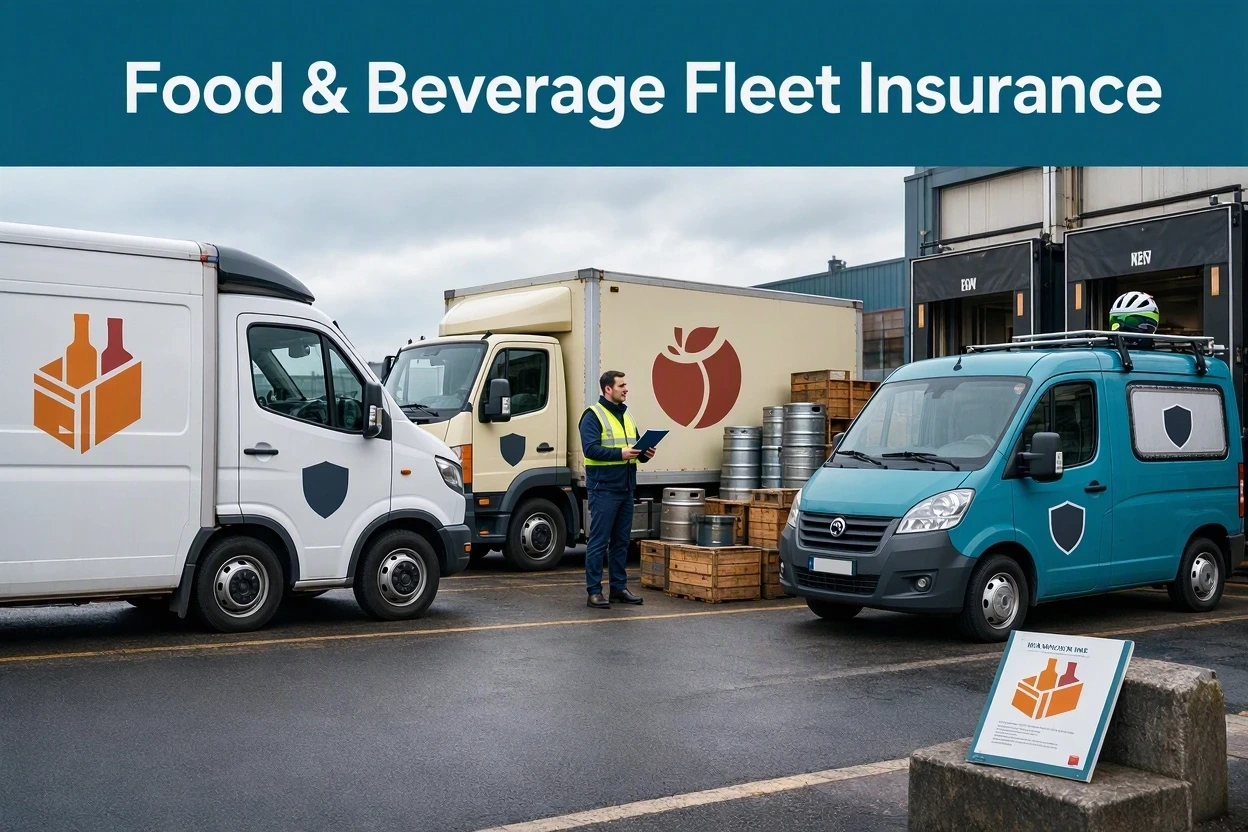
Food & Beverage Fleet Insurance is the commercial coverage that protects the vehicles you use to make, carry, and deliver food and drinks. Whether you run a food truck, a catering company, a beverage distributor, or a meal delivery service, your vans and trucks are working assets that are exposed to accidents, breakdowns, and theft every day. When I ran a catering company with a fleet of four vans, I assumed my personal auto policy would cover everything. Then one of our delivery vans slid on wet pavement, crushed a parked car, and destroyed several hundred dollars’ worth of refrigerated trays. My personal policy denied the claim because the van was used for business. That expensive lesson taught me how fleet coverage really works.
Food & Beverage Fleet Insurance is a commercial auto policy designed for businesses that operate multiple vehicles in their daily operations. It bundles several types of protection into one plan, so you don’t need to buy separate policies for each van or truck. The exact coverage depends on your business, but most policies address liability, physical damage, and the specialized risks of carrying food and drinks.
Think of it as a safety net with several layers. Some layers protect other people if your vehicle causes harm. Others protect your own vehicles and the products inside them. Understanding each layer helps you avoid buying too little or paying for protection you don’t need.
Liability coverage pays for injuries and property damage you cause to other people while driving for your business. If your delivery driver rear-ends another car or injures a pedestrian, liability coverage pays the other party’s medical bills, repair costs, and legal fees up to your policy limit.
This is the most important part of any fleet policy. Many states require minimum liability limits for commercial vehicles, but those minimums are often much lower than what a serious accident costs. I once saw a fleet owner with a state-minimum policy face a $180,000 injury claim after a minor intersection collision. Choosing higher limits, often $1 million for commercial use, usually costs far less than the protection is worth.
Physical damage coverage pays to repair or replace your own vehicles. It comes in two main forms. Collision coverage pays for damage from accidents, regardless of who caused them. Comprehensive coverage pays for losses from theft, vandalism, fire, hail, or hitting an animal.
For food trucks and vans carrying expensive equipment, physical damage coverage matters a great deal. A custom-built food truck can cost well over $100,000, and replacing it after a total loss without coverage would wipe out years of profit. Make sure the actual value of each vehicle, including custom kitchen equipment and wraps, is included in your policy.
Many small food and beverage owners assume their existing policies will cover their vehicles. In most cases, they won’t. Personal auto insurance and standard business liability policies usually exclude vehicles used for commercial purposes, and that exclusion becomes a serious problem when a claim happens.
Fleet insurance closes these gaps by covering your vehicles, drivers, and cargo under a policy written for commercial operations. It also satisfies lender requirements and contract obligations, since many banks, leasing companies, and corporate clients require proof of commercial auto coverage before they will work with you.
Personal auto insurance is written for private driving, commuting, and errands. When you use a personal vehicle to deliver orders or transport catering supplies, insurers often consider that business use and may deny claims. My denied claim happened exactly this way, and I had to pay the damage to the other car out of pocket.
Personal policies also rarely cover employee drivers. If a staff member is driving your van while making a delivery, their personal policy may provide limited protection, and your business could still face a lawsuit for negligent supervision. A proper fleet policy names your drivers and covers their business driving directly.
Food and beverage products are perishable and often valuable, which creates a risk most other industries don’t face. If a refrigerated unit fails during a long delivery route, an entire load of dairy, meat, or prepared meals can spoil before it reaches the customer. Standard auto policies generally don’t cover this kind of loss.
Cargo coverage, sometimes called motor truck cargo insurance, pays for goods you are transporting that are damaged or lost. Some policies include a specific endorsement for refrigeration breakdown, which covers spoilage caused by equipment failure. I learned this after a compressor failed on a Friday evening, and we lost a full catering order before we discovered the problem. Ask specifically whether your policy covers spoilage, because the answer is not always yes.
Not every food or beverage business has the same vehicle needs, so the right policy depends on how you operate. A food truck parked at festivals has different risks from a beverage distributor making daily deliveries across several counties. Matching your coverage to your operations keeps your premiums fair and your protection complete.
Some insurers specialize in the food and beverage sector and understand the equipment, cargo, and route patterns common in these businesses. Working with an agent who knows the industry can save you from buying a generic policy that misses important details.
A food truck is both a vehicle and a working kitchen, which means its insurance needs go beyond ordinary auto coverage. Your policy should address the vehicle itself, the cooking equipment built into it, the propane systems, and the inventory stored inside. Many food truck owners overlook the equipment, then discover that a fire or propane leak damaged thousands of dollars in built-in appliances that weren’t listed on the policy.
When I helped a friend insure her food truck, we listed the vehicle, the generator, the built-in fryers, and the refrigeration units separately. This detail made a real difference when a generator fire later damaged the electrical system. Because the equipment was documented, the claim moved forward without a long dispute.
Catering and delivery businesses face a different set of risks, mostly related to frequent driving, tight schedules, and heavy loads. Drivers are often rushing to meet delivery windows, and vans may be loaded with hot food, chafing dishes, and expensive equipment. Accidents and cargo damage are more common when drivers are under time pressure.
Your policy should include hired and non-owned auto coverage if you sometimes rent vehicles or allow drivers to use their own cars for deliveries. This coverage protects your business when a vehicle you don’t own is involved in an accident during company work. Many small delivery operations overlook this coverage until they need it.
Fleet insurance premiums are calculated using a combination of vehicle details, driver information, business operations, and claims history. Insurers look at what you drive, who drives it, how far it travels, what it carries, and how often accidents or claims have occurred in the past. Understanding these factors helps you predict your costs and find savings.
Premiums can vary widely. A two-vehicle food truck operation in a low-traffic area might pay a fraction of what a ten-van distribution company pays in a dense city. Getting several quotes is the most reliable way to understand what is typical for your situation.
The number of vehicles is the most obvious cost driver, but the type of vehicle matters just as much. Heavier trucks and vans cost more to insure than small cars because accidents involving them tend to cause more damage. Vehicle value also affects physical damage premiums, so a newly wrapped food truck with expensive equipment will cost more to cover than an older, basic van.
Driver records have a major effect on your premium. An insurer will review the driving history of every employee who operates a company vehicle. One driver with multiple violations can raise the cost of the entire fleet. Your location, the distance your vehicles travel, and whether you transport alcohol can also increase your rate.
The most effective way to lower your premium is to reduce the risk your fleet creates. Set clear driving rules, require safety training, and check motor vehicle records before hiring anyone to drive. Many insurers offer discounts for telematics devices that monitor speed and braking, and for fleets that maintain consistent maintenance schedules.
Raising your deductible can also reduce premiums, but only if you have enough cash reserves to cover the deductible when a claim happens. I raised my deductible from $500 to $1,500 and saved about $600 a year, but I kept that difference in a separate account so a claim would never catch me unprepared.
Choosing an insurer is about more than finding the lowest price. The right provider should understand your industry, offer the coverage you need, and handle claims efficiently when something goes wrong. A cheap policy that pays slowly or excludes key risks can cost far more in the end.
Start by comparing at least three quotes from insurers or agents who work with commercial fleets. Make sure each quote lists the same coverage limits and deductibles so you can compare them fairly. Ask whether the provider has experience with food and beverage businesses specifically.
Fleet policies generally come in two structures. A scheduled policy lists each vehicle individually, with its own coverage details. A blanket policy covers all vehicles in the fleet under one set of terms, which makes it easier to add new vehicles without updating the policy each time.
Scheduled coverage gives you more control and clear documentation of each vehicle’s value. Blanket coverage is simpler and often better for growing fleets that frequently add or replace vehicles. I switched from scheduled to blanket coverage when we grew from four vans to seven, and the administrative work dropped significantly. Ask your agent which structure fits your business and how changes are handled.
Before purchasing any policy, ask the agent to explain exactly how the coverage responds in specific situations. Ask whether refrigeration breakdown is covered, whether employee drivers are included automatically, and what happens when you add a new vehicle mid-policy. Ask how quickly claims are typically processed and whether the insurer has a dedicated claims line for commercial clients.
Also ask about state filing requirements for your operation, especially if you transport alcohol or cross state lines. Requirements vary, and an agent who understands them can prevent costly compliance problems. Get every answer in writing before you commit.
Most coverage problems come from avoidable mistakes made during setup or after a policy is in place. Many small owners buy coverage quickly to satisfy a lease or permit, then never review it again. Over time, their business changes, but their policy does not.
Reviewing your policy at least once a year helps you catch these problems early. Look at your current vehicles, drivers, routes, and cargo, and compare them to what the policy actually says. A few minutes of review can prevent a claim denial later.
One of the most common mistakes is failing to list every person who drives a company vehicle. Owners often assume that the people they know well are covered automatically, but insurers usually require each driver to be named and approved. An unlisted driver involved in an accident can lead to a denied claim and personal liability for the business owner.
Create a simple process for adding drivers. Require each new employee to provide a license and consent to a motor vehicle record check before they touch a company vehicle. Notify your insurer whenever someone is hired or leaves, so your policy always reflects who is driving.
Many food and beverage owners undervalue their cargo, especially when inventory changes daily. A catering van loaded for a large wedding might carry several thousand dollars in food, rentals, and equipment on a single trip. If your cargo limit is set at a few hundred dollars, a loss could leave you paying the difference out of pocket.
Estimate your highest-value load and set your cargo limit to cover it. Review that number whenever you take on a larger contract or change your product mix. I once discovered that our cargo limit covered only a fraction of a large beverage shipment we had started delivering, and I corrected it the same week.
Even well-managed fleets have accidents and losses. What separates a manageable claim from a costly one is how quickly and carefully you respond. The steps you take in the first hours after an incident often determine how smoothly the claim will proceed.
Keep your claim contact information in every vehicle, along with your policy number and a simple incident checklist. Drivers who know what to do in a stressful moment protect your business and their own safety.
Document everything as soon as it is safe to do so. Take photos of the vehicles, the scene, any damaged cargo, and any visible injuries or property damage. Record the names and contact information of other drivers and witnesses, and write down the time, location, and weather conditions while they are still fresh in memory.
For cargo losses, photograph the damaged products before discarding them, and keep temperature logs if your refrigeration system records data. Those logs can prove when a breakdown occurred and support a spoilage claim. After my compressor failure, the temperature records were the single most useful piece of evidence we had.
Once you report a claim, an adjuster will be assigned to investigate. Cooperate fully, answer questions honestly, and provide the documentation they request. Delays often happen when owners are slow to send records or give incomplete descriptions of what happened.
Keep a written log of every call and email with the insurer, including dates, names, and what was discussed. If you disagree with the adjuster’s estimate for repairs or losses, ask for the calculation in writing and request a second opinion from your own repair shop. Clear communication and organized records make the process far less stressful.
Food & Beverage Fleet Insurance is one of the most practical investments a food or beverage business can make. It protects your drivers, your vehicles, your cargo, and your reputation when the unexpected happens on the road. Personal auto policies and general business coverage were not designed for this kind of work, and relying on them leaves serious gaps.
Start by listing every vehicle, driver, and type of cargo your business uses. Compare quotes from insurers who understand the food and beverage industry, and choose limits that reflect what an accident or spoilage event would actually cost. Review your policy every year and update it whenever your operations change.
My own mistakes taught me that good coverage is not about expecting the worst. It is about being prepared so that one bad day does not threaten the business you spent years building. Take the time to get this right now, and your fleet can keep moving through whatever the road brings.
Protecting Restaurants, Distributors, Producers, and Bars The Ultimate Food & Beverage Insurance Guide for 2027… Read More
How Restaurants and Distributors Can Avoid Underinsurance in 2027 Food & Beverage Inventory Insurance protects… Read More
Protecting Margins When Costs and Disruptions Rise Restaurant Profitability and Insurance in 2027 are closely… Read More
Workers' Compensation, EPLI, and Wage-Related Risk The Hidden Insurance Costs of Food & Beverage Labor… Read More
POS Systems, Automation, AI, and Cyber Risk Technology Insurance for Food & Beverage Companies protects… Read More
Airbnb arbitrage insurance is the specialized coverage you absolutely must have if you're renting properties… Read More
This website uses cookies.