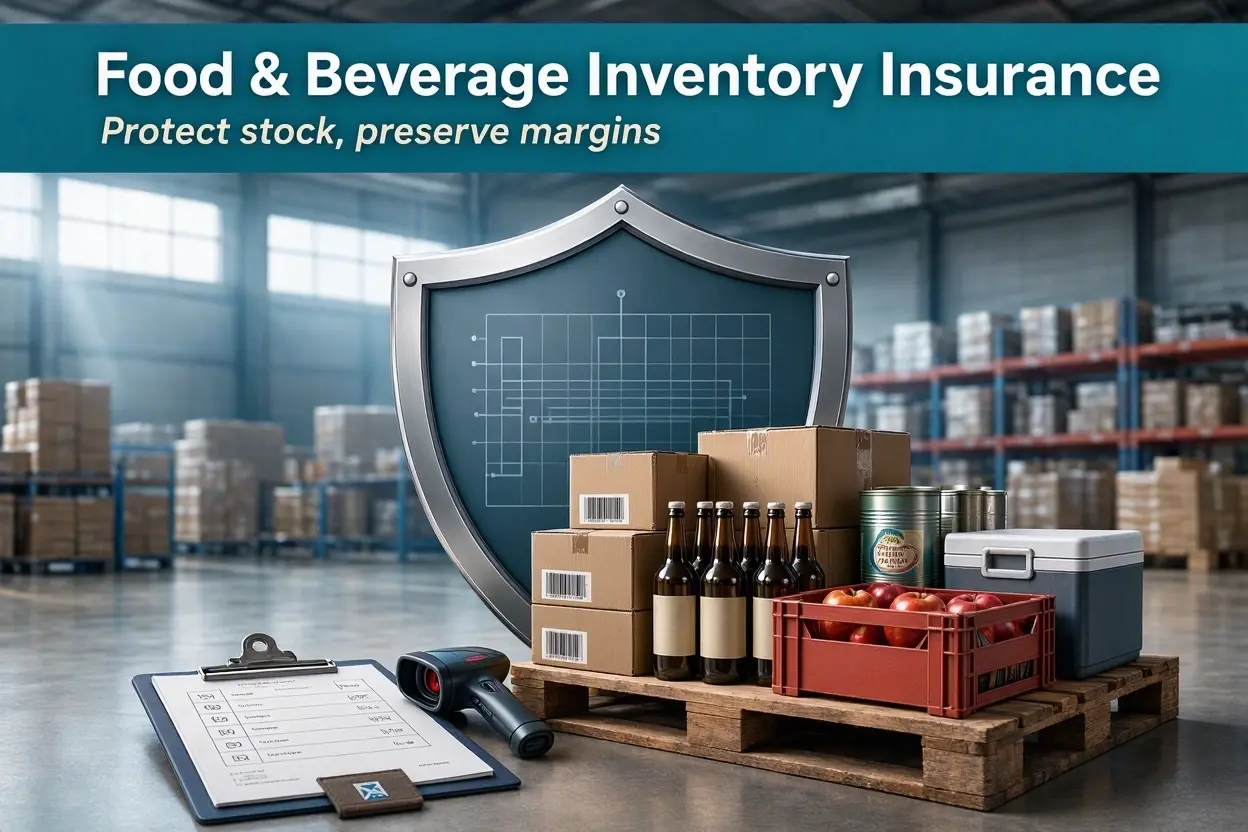
Food & Beverage Inventory Insurance protects the products you store, prepare, and sell, but many owners discover too late that their coverage falls short of what they actually have on hand. Food spoils, beverages get damaged in transit, and a single freezer failure or warehouse fire can wipe out tens of thousands of dollars in stock overnight. When I started my own distribution business, I insured the building and the delivery trucks carefully, yet I barely thought about the pallets of product sitting inside. A fire in our storage facility revealed that my inventory limit was less than half of what we actually held. This guide explains how to calculate your real inventory value, avoid underinsurance, and protect your business as you plan for 2027.
Food & Beverage Inventory Insurance is a form of commercial property coverage that pays to replace or repair the stock you own when it is lost, damaged, or destroyed by a covered event. It typically sits inside a broader business property policy as a line item for “business personal property” or “stock.” Coverage usually applies to ingredients, finished goods, beverages, packaging, and sometimes supplies held for sale.
The policy generally pays when your inventory is damaged by fire, theft, water, windstorms, or other perils named in your contract. Spoilage is handled differently. Many standard policies exclude spoilage unless it results from a covered event, such as a power outage caused by a storm or a breakdown that qualifies under an equipment endorsement. Understanding these distinctions prevents unpleasant surprises at claim time.
Inventory is only one part of business personal property. Furniture, kitchen equipment, computers, and fixtures are also covered under the same category, but each carries its own valuation. Your inventory limit should reflect only the goods you hold for sale, while equipment should be insured at replacement cost separately. Mixing these categories is a common source of confusion.
When I first reviewed our policy, the business personal property limit was a single number covering everything inside the warehouse. We had not separated our fixed assets from our stock, so we had no clear view of how much inventory was actually protected. Splitting the schedule gave us a far more accurate picture.
Spoilage coverage is one of the most misunderstood parts of food inventory protection. A cooler that fails over a holiday weekend can destroy an entire load of dairy, meat, or prepared foods. Some policies pay for this loss only if the breakdown is covered under an equipment breakdown endorsement, while others exclude it entirely. Ask specifically how spoilage is treated before you assume you are protected.
We once lost a full pallet of refrigerated product when a compressor failed on a Sunday night. The product was insured for fire and theft, but the spoilage was not covered under our basic policy. Once we added a refrigeration breakdown endorsement, the next incident was handled quickly because the sensor logs and maintenance records supported the claim.
Underinsurance means your coverage limit is lower than the value of what you actually would need to replace after a loss. In the food and beverage sector, this gap often develops gradually. Inventory levels rise with new contracts, prices increase with supplier costs, and seasonal peaks push stock far beyond what you carried the previous year. Meanwhile, the policy limit may stay exactly the same.
Underinsurance can also come from a simple assumption. Many owners set their limit based on what they carried when they first bought the policy. They forget that inventory grows with the business and that replacement costs change with the market. The result is a policy that looks adequate on paper but leaves a large hole in a real emergency.
Some commercial property policies include a coinsurance clause. Coinsurance requires you to insure your property to a certain percentage of its total value, often 80% or 90%. If your limit falls below that percentage at the time of a loss, the insurer reduces your claim payment proportionally, even if the loss itself is covered. This penalty can be severe.
Suppose your inventory is valued at $400,000, but your policy limit is $200,000, and the policy requires 80% coinsurance. That requirement equals $320,000 in coverage. If you suffer a $100,000 loss, the insurer may pay only about $62,500 after applying the penalty. Owners often learn about coinsurance only after a claim, which makes it one of the most expensive surprises in this area.
Many food businesses carry dramatically different inventory levels across the year. A distributor preparing for holiday orders may hold far more product in November than in February. A restaurant group stocking for summer festivals may hold extra beverages and packaging for a few months. If the policy limit reflects only the average level, the peak periods may be left underinsured.
We learned this during our first holiday season. Our inventory peaked at nearly double the average, and our policy still reflected the calm months. We were exposed for six weeks without realizing it. Now we review our inventory values monthly and adjust the limit before peak seasons begin.
Accurate valuation is the foundation of avoiding underinsurance. Before you can choose a sensible limit, you need to know what your inventory is worth at the moment a loss could happen. This usually means calculating replacement cost, which is what it would cost to buy the same products again from your suppliers.
Some policies value inventory at actual cash value, which subtracts depreciation for damaged goods. Others use replacement cost, which pays what it costs to restock. For food and beverage businesses, replacement cost is generally more useful, because perishable items do not depreciate in the traditional sense but their supplier prices can change quickly.
Create a worksheet listing every category of product you carry. For each category, record the average quantity on hand, the peak quantity during busy periods, and the current supplier cost per unit. Multiply these figures to estimate the replacement value at both average and peak levels. This simple exercise often reveals gaps that owners never noticed.
When I built our first worksheet, the average inventory value came to $185,000, but the peak value during a seasonal promotion reached $340,000. Our policy limit was $150,000. The worksheet showed us exactly where the shortfall was, and it gave us a clear number to bring to our broker.
Inventory value is often larger than the food itself. Packaging materials, cups, lids, labels, cleaning supplies sold to customers, and bulk condiments all have value. Stock in transit, meaning product on a truck or in a shipping container, may need separate coverage or an endorsement. Overlooking these categories is a frequent cause of underinsurance.
A distributor I know discovered that her warehouse stock limit excluded packaging materials entirely. A fire destroyed a large supply of branded containers that cost nearly $28,000 to replace. The claim was denied in part because those materials were classified as supplies rather than inventory. Reviewing definitions in the policy would have prevented that gap.
Once you know your real inventory value, you need to choose a limit that covers your highest realistic exposure. Some owners aim to cover their average value, while others plan for their peak. The safer approach for most food businesses is to insure to peak levels, especially where seasonal swings are significant.
Balancing cost and protection is essential. Insuring to peak levels increases premiums, but the expense is often modest compared to the cost of a single uncovered loss. Many businesses find that a limit set slightly above their peak value provides a comfortable margin for unexpected growth or supplier price increases.
Some insurers offer reporting forms or variable limits for inventory. These arrangements let you report your actual inventory values periodically, often monthly or quarterly, and adjust your coverage accordingly. Reporting forms can be an excellent solution for businesses with large seasonal changes, because the limit tracks reality more closely than a fixed number.
Reporting forms require discipline. If you forget to submit a report, you may face premium adjustments or limited coverage. Set a recurring reminder, assign responsibility to a specific team member, and keep records of every submission. We use a monthly calendar alert and a shared spreadsheet, which has made the process almost effortless.
An agreed value endorsement removes the coinsurance penalty by having you and the insurer agree on the value of your property before the policy begins. When you submit a current statement of values, the insurer agrees to pay the full covered amount up to the stated limit, without applying the coinsurance reduction. This can be a valuable protection for businesses that fear penalties.
Agreed value usually requires an accurate and recent valuation. The insurer may ask for supporting documents, such as purchase invoices or inventory logs. Once we completed an accurate valuation and added an agreed value endorsement, our broker explained that the coinsurance concern was resolved for the policy period. That peace of mind was worth the paperwork.
Good records determine how quickly and fully a claim is paid. Insurers need to verify what you lost, how much it was worth, and what caused the loss. Without documentation, even a clearly covered event can turn into a long dispute.
Inventory documentation should be kept current and stored in a place that survives the same event that damages your property. Cloud storage, off-site backups, and copies held by your accountant or broker are all useful safeguards. A spreadsheet stored only on a computer in a burning warehouse will not help you.
Keep purchase invoices, supplier statements, inventory counts, and sales records organized by month. Photograph your storage areas periodically, especially before peak seasons. Maintain temperature logs for refrigerated and frozen storage, along with maintenance records for all cooling equipment. These documents help establish both the value of your stock and the cause of any loss.
After our fire, our adjuster asked for six months of purchase invoices and monthly inventory counts. We had kept both, so the valuation process moved within weeks. Businesses without those records often spend months reconstructing them, which delays payment and strains cash flow.
When a loss occurs, document everything before discarding damaged product. Take dated photographs of affected pallets, shelves, and cooler contents. Record the quantity and type of each damaged item, and note any product that can be salvaged or sold at a reduced price. Do not dispose of spoiled goods until the adjuster has had a chance to review them, unless health or safety rules require immediate removal.
Keep a written log of every conversation with the insurer and any vendors who assist with cleanup or restoration. Record dates, names, and decisions. This log becomes essential if the claim is disputed or if you need to explain the timeline later.
Most underinsurance problems come from a few predictable mistakes. Owners often set limits once and never revisit them, assume that all their products are covered when they are not, or confuse spoilage coverage with fire coverage. Recognizing these traps early makes them easier to avoid.
Another common mistake is storing inventory at locations the policy does not describe. If you move product to a rented warehouse, a food truck, or a third-party cold storage facility, your coverage may not extend there automatically. Always notify your broker before inventory moves to a new location.
Many distributors use public cold storage or consignment warehouses. The contract with the storage provider may limit its liability to a small amount per pallet, which leaves you exposed if the facility loses your product. Your own policy may or may not cover goods stored elsewhere, depending on its wording.
A distributor I advise stored a large shipment at a third-party cold facility. A power failure spoiled the entire load, and the storage company’s contract limited its liability to a few thousand dollars. Because the owner’s policy did not include off-premises coverage for that location, most of the loss fell on the business. The fix was simple: add the facility to the policy and confirm the coverage in writing before the next shipment.
Underestimating peak inventory is perhaps the most expensive mistake of all. Owners often base their limits on normal months and forget that the holiday rush or a large contract can increase stock by 50% or more. A loss during that window can be far larger than the limit the policy provides.
Set a calendar reminder to review inventory values before every major season. Compare your peak counts with your current limit, and adjust the policy before the rush begins. The few hours spent on this review can prevent a loss that would otherwise threaten the entire year.
Insurance is most effective when it works alongside sound operating practices. Reducing the chance of loss keeps premiums manageable and reduces the strain on your coverage. Many of the best protections are inexpensive and easy to maintain.
Refrigeration monitoring is one of the most valuable investments. Connected sensors can alert staff by phone when temperatures drift, allowing you to respond before product is lost. Combined with maintenance contracts and documented temperature logs, these tools strengthen both your operations and your insurance position.
Install temperature sensors in every refrigerated and frozen area, with alerts sent to multiple managers. Schedule preventive maintenance for compressors, condensers, and door seals. Keep records of every service visit, since insurers and adjusters often ask for them after a spoilage event.
After we added monitoring and a quarterly maintenance schedule, we caught a failing door gasket before it caused a loss. The repair cost $140. Had the gasket failed during a weekend, the potential loss would have exceeded $20,000. Small investments like these protect both inventory and insurance terms.
Theft and vandalism are real threats to inventory, especially for high-value beverages and specialty ingredients. Install lighting, cameras, and access controls in storage areas. Limit key access, rotate stock to prevent waste, and conduct periodic counts to detect shrinkage early. Many insurers offer premium credits for documented security measures.
Stock rotation also reduces spoilage. Using first-in, first-out methods keeps older product moving and minimizes the amount of inventory that expires before it sells. Good rotation practices make your inventory records more accurate, which supports both operations and claims.
Looking ahead to 2027, food and beverage businesses should expect continued changes in supplier pricing, shipping conditions, and insurer requirements. Inventory values may rise as product costs shift, and insurers may ask for more detailed valuation and temperature documentation. Planning early gives you time to adjust coverage without rushing.
Start by building a valuation worksheet for the coming year, using realistic projections for growth, seasonal peaks, and supplier price changes. Share your projections with your broker in advance of renewal. Ask whether the policy includes agreed value, reporting form options, spoilage coverage, and off-premises protection. Confirm each answer in writing.
Begin your renewal preparation at least 60 days before the policy expires. Gather updated inventory values, recent loss history, equipment maintenance records, and a list of all storage locations. Submit this information early so the insurer has time to review it, and compare proposals from several carriers before deciding.
A rushed renewal often leads to rushed coverage decisions. Give yourself time to read the proposed forms, ask questions about exclusions, and confirm limits. The extra effort is one of the simplest ways to avoid underinsurance.
Each year, compare your actual inventory values with your policy limits, check your spoilage and equipment breakdown terms, and confirm that every storage location is listed. Update the policy whenever you open a new facility, add a product line, or sign a large contract. Coverage should evolve with the business.
I keep a single page summarizing these checks and review it with my broker every year. The habit has eliminated the surprises that once caught us off guard. A few minutes of attention can prevent a loss from becoming a crisis.
Food & Beverage Inventory Insurance works best when your limits match the real value of what you hold, including peak seasons, packaging, stock in transit, and off-site storage. Underinsurance rarely feels dangerous until a loss occurs, which is why regular valuation and honest conversations with your broker matter so much. Protecting your inventory protects your cash flow, your customers, and your reputation.
Start by building a worksheet that captures average and peak inventory values across every category. Compare those numbers with your current limit, check for coinsurance requirements, and consider reporting forms or agreed value if your stock fluctuates. Document your records carefully, and schedule a review before each busy season.
My own experience taught me that underinsurance is almost always preventable. The fire that exposed our gap was painful, but it gave us a clear process we still use today. Take the time to measure your inventory now, and make sure your 2027 coverage reflects the business you are actually running.
Protecting Restaurants, Distributors, Producers, and Bars The Ultimate Food & Beverage Insurance Guide for 2027… Read More
Protecting Margins When Costs and Disruptions Rise Restaurant Profitability and Insurance in 2027 are closely… Read More
Workers' Compensation, EPLI, and Wage-Related Risk The Hidden Insurance Costs of Food & Beverage Labor… Read More
POS Systems, Automation, AI, and Cyber Risk Technology Insurance for Food & Beverage Companies protects… Read More
Food & Beverage Fleet Insurance is the commercial coverage that protects the vehicles you use… Read More
Airbnb arbitrage insurance is the specialized coverage you absolutely must have if you're renting properties… Read More
This website uses cookies.