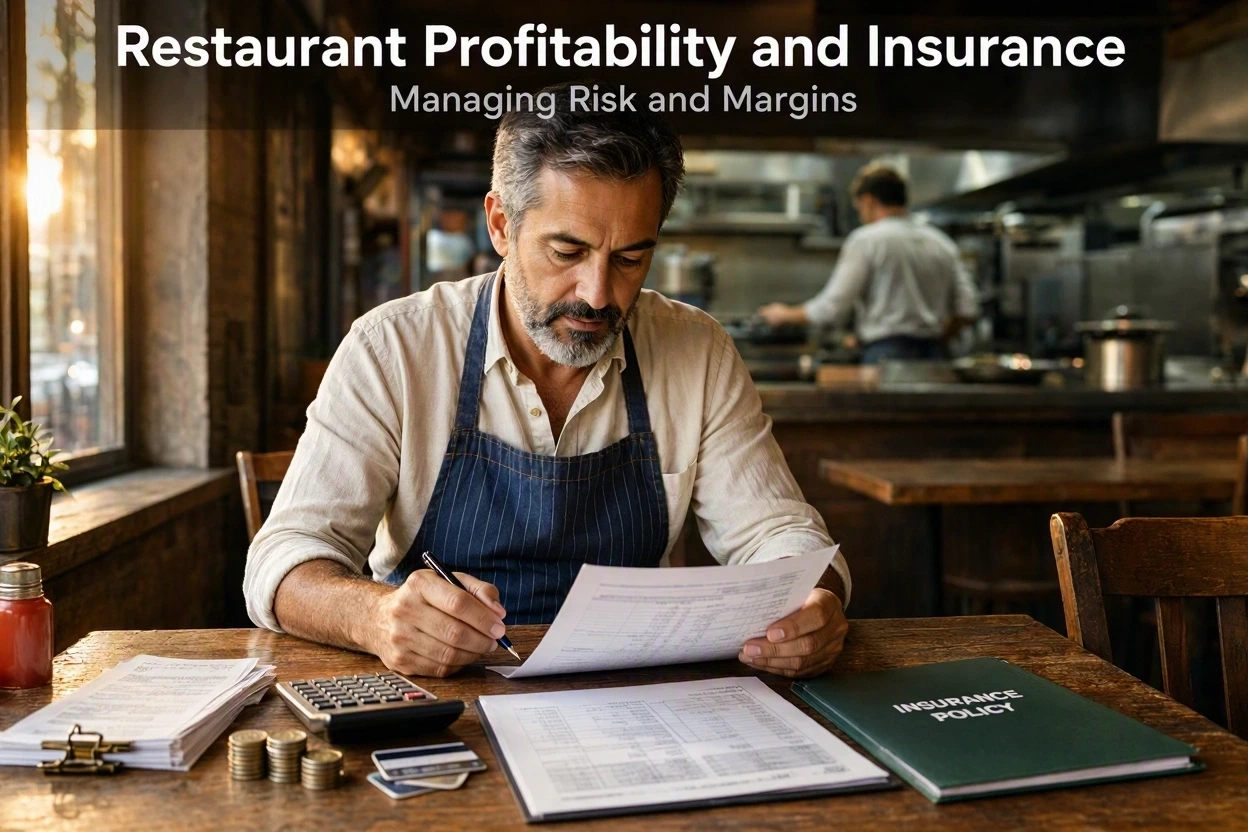
Restaurant Profitability and Insurance in 2027 are closely linked because the policies you carry can either protect your margins or quietly erode them. Food costs remain volatile, labor is expensive, and a single equipment failure or utility outage can wipe out a week of profit. When I took over my family’s diner, I tracked every expense except insurance, which I treated as a fixed cost I could ignore. Two premium increases and one month-long closure after a pipe burst taught me otherwise. This guide explains how insurance affects your bottom line, where the biggest risks hide, and how to protect your margins without leaving your restaurant exposed.
Most restaurant owners know their food cost percentage and prime cost down to the decimal. Fewer track insurance with the same discipline, even though it can quietly consume several percent of revenue. Understanding where every dollar goes is the starting point for protecting profit, and insurance deserves a clear line in that picture rather than a vague place in overhead.
Restaurant margins are thin, and small leaks matter. A restaurant with a 6% net profit on $1.2 million in annual sales keeps about $72,000 after all expenses. If insurance costs rise by $6,000 in one year, that increase alone cuts your profit by roughly 8%. The math becomes sobering quickly, especially when several expense categories rise at the same time.
When I first sat down with my accountant to review our numbers, we discovered that our total insurance spending sat at about 3.5% of revenue, once premiums, deductibles, and small uninsured losses were added together. That figure was higher than I expected and higher than most of the peers I spoke with. It became the first target in our plan to protect margins.
Insurance is easy to overlook because it arrives as a renewal notice rather than a daily purchase. Owners sign once a year, pay the premium, and move on. The cost feels distant until a claim, an audit, or a sharp increase forces attention. By then, the damage to your budget is already done.
Insurance also hides in several places at once. Part of it appears in property expenses, part in payroll for workers’ compensation, and part in legal fees or repair bills after an incident. Grouping these costs gives you a truer picture of what protection really costs and whether your current coverage is doing its job.
Restaurant owners across the country have reported higher insurance costs in recent years, driven by rising repair prices, increased litigation, and insurers’ growing caution about food service risks. Specific rates vary by location and carrier, so it is wise to check current quotes rather than rely on general trends. What matters most is understanding the forces that push costs upward so you can respond intelligently.
Several pressures tend to push premiums higher in the current environment. Property insurers have faced higher rebuilding and equipment replacement costs, which feed into the rates they charge. Liability carriers have seen larger jury awards in some regions, and insurers often respond by raising base rates across the food service sector. Cyber insurers have tightened underwriting as restaurants process more digital payments and online orders.
At my restaurant, our property premium rose 18% at one renewal, even though we had filed no claims that year. The carrier pointed to higher replacement costs for commercial kitchen equipment and to broader market trends. That increase was not a penalty for poor performance. It was simply the new cost of staying insured, which meant we had to plan for it.
Small increases compound quickly. A 5% premium hike in one line, combined with a 4% rise in another and a deductible increase in a third, can add up to a noticeable hit even when each change seems minor on its own. Owners often approve each renewal individually and never see the cumulative effect until profit drops.
I now track insurance cost as a percentage of revenue each quarter. When that percentage climbs more than half a point, I investigate immediately. This habit has helped me catch increases that would otherwise have blended into the background of our monthly statements.
Some risks are more expensive for restaurants than they first appear. The most damaging events often combine physical damage, lost income, and legal exposure. Understanding these risks helps you decide where to focus your coverage and your prevention efforts.
Commercial kitchens depend on refrigeration, ventilation, cooking equipment, and water systems. When one fails, the restaurant may be unable to operate, even if the dining room is undamaged. A walk-in cooler failure can destroy thousands of dollars in inventory overnight. A grease fire can close a kitchen for weeks while repairs and inspections are completed.
Our pipe burst in the middle of winter. Water flooded the prep area and damaged flooring, wiring, and two refrigeration units. We were closed for nine days, and the physical repairs cost about $31,000. The larger shock was the lost profit: roughly $14,000 in net income that the restaurant would normally have earned during those days. Without business interruption coverage, that loss would have landed entirely on our margins.
Liability exposure is another area where restaurants can lose money quickly. Guests slip on wet floors, choke on food, or claim they became ill after a meal. Even when a claim is weak, defending it costs money. Standard general liability policies typically include defense coverage, but deductibles and exclusions can leave gaps.
A guest once slipped near our hostess stand after a rainstorm and claimed a back injury. The claim was ultimately settled for $7,500, and our general liability deductible was $2,500. We also spent several hours reviewing security footage and incident reports, which pulled managers away from the floor during a busy evening. The experience convinced me to review our floor-mat program, incident logs, and deductible structure together, not as separate items.
Coverage decisions directly affect profit. Buying too little leaves you exposed to disruptions that can close your doors. Buying too much means paying for protection you rarely need. The goal is coverage that matches your real risks, not the cheapest policy or the most expensive package a broker offers.
Business interruption coverage replaces net income and continuing expenses when a covered event forces you to close or operate at reduced capacity. For restaurants, this coverage is often the most important protection because revenue depends on being open. Without it, rent, payroll commitments, and loan payments continue even when sales stop.
When reviewing business interruption coverage, check the waiting period before benefits begin, the length of the coverage period, and how income is calculated. Many restaurant owners underinsure this coverage because their revenue fluctuates. A realistic estimate should use your strongest recent months, not the slowest ones, while accounting for seasonal swings.
After our pipe burst, I rebuilt our business interruption calculation using three years of sales data and a realistic recovery timeline. We increased the coverage limit and shortened the waiting period. The premium rose modestly, but the change would have paid nearly all of our lost profit during the nine-day closure.
Deductibles are a major lever in restaurant insurance. A higher deductible lowers premiums, but it also means you pay more out of pocket when a claim occurs. The right choice depends on your cash reserves. A deductible you cannot comfortably pay during a bad month is not a savings; it is a risk.
I raised our property deductible from $1,000 to $2,500 and cut the premium by about $900 a year. I placed the difference in a separate reserve account, so a claim would never catch us unprepared. Over several years, the reserve has covered two small losses without touching operating cash, and the lower premium has improved margins consistently.
Lowering insurance costs does not have to mean weakening your protection. Many savings come from reducing risk, improving your documentation, and shopping your coverage with care. These steps protect margins while keeping your restaurant properly insured.
Insurers reward restaurants that actively manage risk. Regular equipment maintenance, documented hood cleaning, fire suppression inspections, and staff safety training can all help support lower rates or better terms at renewal. Carriers want evidence that your operation is well run, and records are the proof.
We signed a service contract for quarterly hood cleaning and semiannual refrigeration inspections. The contract cost about $2,200 a year, but it created a clear maintenance history. At renewal, our carrier applied a credit that reduced the property premium by roughly $1,100. The service also prevented at least one potential fire hazard that the technician flagged during an inspection.
Insurance markets change, and loyalty does not always produce the best price. Getting quotes from several carriers or working with a broker who represents multiple insurers can reveal meaningful differences in cost and coverage. Compare policies line by line rather than focusing only on the bottom-line premium, since coverage terms can vary considerably.
Bundling property, general liability, and business interruption coverage with one carrier sometimes earns a discount. However, bundling should never be the only consideration. A slightly cheaper bundled policy with weaker business interruption terms may cost far more in a real disruption. Always check the details before committing.
Disruptions rarely arrive one at a time. A storm can damage the building, knock out power for days, and spoil inventory all at once. Preparing for these combined events protects both your revenue and your ability to reopen quickly.
Supply chain problems and utility outages can close a restaurant as effectively as physical damage. A power outage may spoil refrigerated stock, while a supplier shortage can force a shortened menu that reduces sales. Some business interruption policies cover losses caused by utility interruptions, but many require the outage to originate off premises and last longer than a certain period.
When a regional power outage lasted almost two days last year, we lost a large portion of our refrigerated inventory. Our spoilage was not covered because the policy required a longer outage before the provision applied. We have since added utility service interruption coverage and documented our refrigeration temperature logs more carefully. These steps protect us in a future outage without requiring us to absorb the full loss.
Point-of-sale systems, online ordering platforms, and digital payment processing are now essential to restaurant revenue. A ransomware attack or a cloud platform outage can stop orders for hours or days. Cyber coverage can help pay for recovery, lost income, and certain legal costs, but only if the policy is written to address these events.
A vendor outage once took our online ordering platform offline during a busy holiday weekend. We could not accept orders for most of a day, and the lost delivery sales were significant. We now ask our broker whether our policy includes dependent business interruption coverage for key technology vendors. Reviewing these details before a problem occurs is far less stressful than discovering the gap afterward.
Insurance decisions should not be made once a year and forgotten. A simple, recurring review keeps your coverage aligned with your operation and your margins. The best routine is short enough to repeat consistently and detailed enough to catch problems early.
Each quarter, compare your insurance costs with your total revenue and your net profit. Note any change in premiums, deductibles, or claims expenses. If the insurance percentage rises noticeably, investigate the cause before the next renewal arrives. Often a single item, such as a higher payroll audit or a new equipment schedule, explains the increase.
This check also reveals whether your coverage still fits your business. If you added a catering operation, expanded your menu with new equipment, or increased seating capacity, your exposure has changed. Updating your policy during the year is usually easier than correcting problems after a claim.
Once a year, sit down with your broker or agent and walk through every policy line by line. Confirm that your property values reflect current replacement costs, that your business interruption figures use recent sales data, and that your liability limits match the size of your operation. Ask what has changed in the market and whether your carrier offers new options.
I bring a written list of questions to every annual review. What is our waiting period? Does our policy cover equipment breakdown? Are employee claims and wage-related defense costs included? Are our cyber and vendor disruption protections current? Writing the questions down keeps the conversation focused and ensures nothing important gets rushed.
Restaurant Profitability and Insurance in 2027 depend on understanding how risk, cost, and coverage interact. Insurance is not just a monthly expense to tolerate. It is a tool that can keep a single disaster from erasing a year of effort. Treating it as a strategic part of your margin plan gives you more control over the results.
Start by calculating your total insurance spending as a percentage of revenue, including premiums, deductibles, and uninsured losses. Review your business interruption coverage using recent sales data, and check whether your deductibles match your cash reserves. Build simple risk reduction habits, such as maintenance contracts and documented training, and schedule quarterly and annual reviews that keep your coverage current.
My own restaurant survived a pipe burst, a premium spike, and a lawsuit because we finally treated insurance as part of our profit strategy. The changes we made were not dramatic, but they were consistent. Protect your margins by protecting your operation, and review your coverage before the next disruption forces the decision for you.
Protecting Restaurants, Distributors, Producers, and Bars The Ultimate Food & Beverage Insurance Guide for 2027… Read More
How Restaurants and Distributors Can Avoid Underinsurance in 2027 Food & Beverage Inventory Insurance protects… Read More
Workers' Compensation, EPLI, and Wage-Related Risk The Hidden Insurance Costs of Food & Beverage Labor… Read More
POS Systems, Automation, AI, and Cyber Risk Technology Insurance for Food & Beverage Companies protects… Read More
Food & Beverage Fleet Insurance is the commercial coverage that protects the vehicles you use… Read More
Airbnb arbitrage insurance is the specialized coverage you absolutely must have if you're renting properties… Read More
This website uses cookies.



View Comments
Keep up the superb piece of work, I read few articles on this website and I believe that your site is really interesting and holds circles of wonderful information.